Lawmakers Demand End to NIH Funding for Fauci-era ‘Wuhan West’ bat lab in Colorado (UPDATED)
- Citing White Coat Waste investigations, DOGE Senate Chair Joni Ernst (R-IA) and Rep. Paul Gosar (R-AZ) are demanding that the National Institutes of Health immediately cancel spending on a Fauci-funded bat breeding and experimentation lab on U.S. soil.
- Since 2023, White Coat Waste (WCW) has been campaigning to cut funding for the establishment of a dangerous bat virus lab at Colorado State University (CSU) by Wuhan-tied bat experimenters in collaboration with the disgraced EcoHealth Alliance (EHA) and Dr. Fauci’s division of the NIH
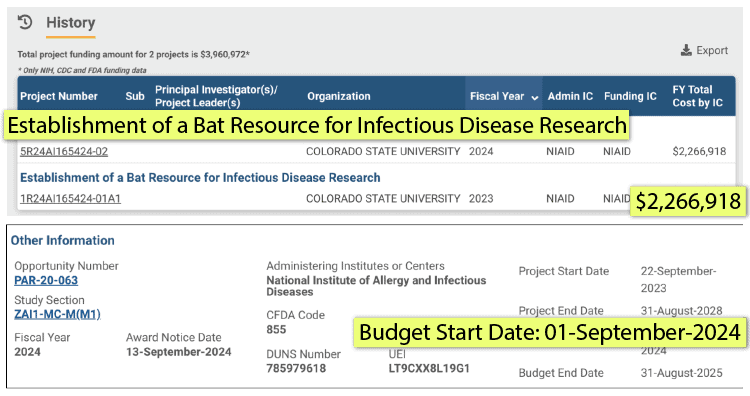
- WCW’s investigation revealed how the CSU lab has received $13 million from the NIH to date, including an additional $2.1 million as recently as September 2025 under Director Jay Bhattacharya.
- WCW open records requests have unearthed photos of CSU’s bat experiments and history of animal lab accidents and wasteful taxpayer-funded virus experiments on bats.
UPDATE (1/12/26): Citing WCW investigations, Sen. Joni Ernst (R-IA) and Rep. Paul Gosar (R-AZ) sent a letter to NIH Director Jay Bhattacharya demanding that funding for the new CSU bat lab be cut “immediately.”
SHOCKING: Wuhan-style bat lab is being built in Colorado
“The exact same people who were behind the gain-of-function disaster in Wuhan … are setting up a bat lab here on US soil with funding from Dr. Fauci.”
White Coat Waste first exposed this “disaster right out of Dr.… pic.twitter.com/847nN5tgFZ
— White Coat Waste (@WhiteCoatWaste) January 15, 2026
Taxpayers deserve answers and accountability for why NIH has poured nearly $13 million into risky live bat research, with millions more still pending, despite serious biosafety concerns and unanswered questions about COVID-19’s origins. @WhiteCoatWaste @SenJoniErnst…
— Rep. Paul Gosar, DDS (@RepGosar) January 13, 2026
UPDATE (10/14/25): Despite widespread public opposition and Congressional pressure, the NIH under Director Jay Bhattacharya extended funding for CSU’s new bat virus lab and doled out another $2.1 million for the project on September 15, 2025, despite criticizing the lab in 2024 as having “no upside.”
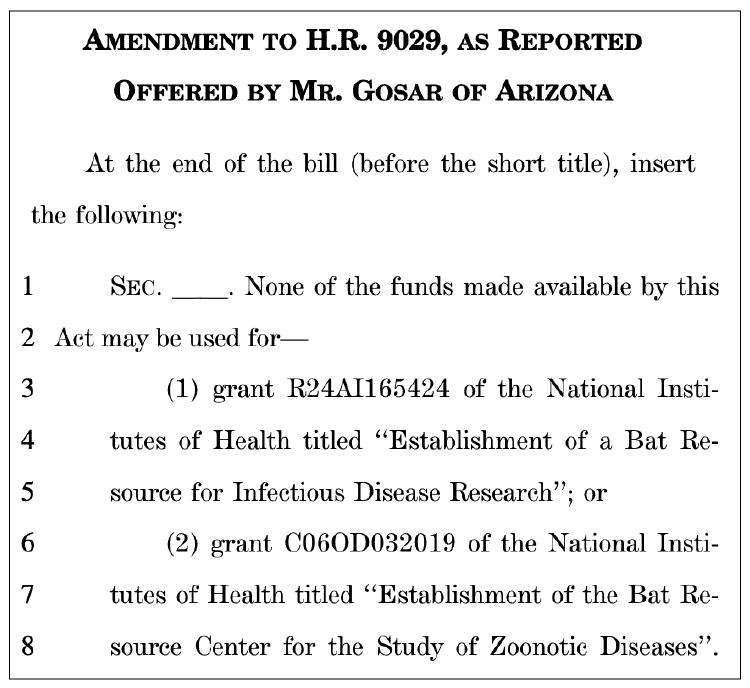
UPDATE (5/23/25): Citing WCW’s investigation, Members of Congress led by Rep. Paul Gosar (R-AZ) are requesting that funding for CSU’s new bat lab be completely cut in the NIH’s 2026 spending bill.
ORIGINAL POST (2/27/25)

Photos of CSU’s taxpayer-funded bat experiments and virus-hunting obtained by White Coat Waste via state and federal open records investigations.
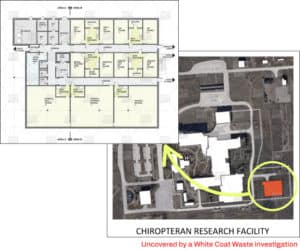
In 2023, White Coat Waste (WCW) first exposed how, funded by the National Institutes of Health (NIH) and State of Colorado, $13 million of taxpayers’ money was being wasted by Colorado State University (CSU) and Wuhan lab partner EcoHealth Alliance (EHA) to build a new lab at CSU and import hundreds of bats from Asia to establish a new breeding colony and infect them with deadly viruses, including COVID, Ebola and Nipah.
 Following WCW’s campaigns and lobbying and a subsequent federal action, EcoHealth Alliance’s taxpayer funding was suspended, ending its role in the scheme to import bats from Asia and establish this menacing breeding colony on US soil.

The defunding of EHA from this dangerous taxpayer–funded project was a major victory for animals and taxpayers, and it is currently unclear how CSU will source its Asian bats without their help. However, we’ve now revealed that the NIH is still eager to move forward with the project minus EHA; and gave CSU an additional $2.3 million to do so just two months ago.
Through a Colorado Open Records Act (CORA) request to CSU, WCW obtained photos, videos, and other documents that provide new insight into the virus-hunting and bat experiments CSU has been conducting.
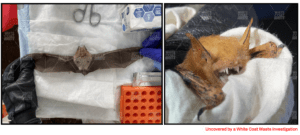
Photos of CSU’s taxpayer-funded bat experiments and virus-hunting obtained by White Coat Waste via state and federal open records investigations.
Working with deadly and highly contagious pathogens such as Zika, rabies, Nipah, and various coronavirus strains, CSU white coats have been infecting bats, watching them suffer through the painful infection, and killing any bats that survive the experiments.
 Similar to white coats in Wuhan, they have genetically modified the coronavirus; creating three new strains of the virus and infecting 162 bats with the novel pathogen.
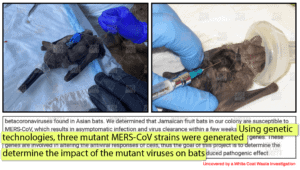
Photos of CSU’s taxpayer-funded bat experiments and virus-hunting obtained by White Coat Waste via state and federal open records investigations.
Documents obtained via CORA detail starvation protocols; where bats are forced into “nutritional stress” so that white coats can observe if malnourishment damages their immune system (as it does in humans and other species).

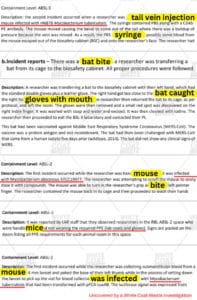
Establishing a research facility with such stark similarities to the Wuhan lab, suspected to be the origin of the COVID-19 pandemic, is a grave danger to the American people as is. But even further, WCW’s investigation uncovered a long history of animal lab accidents at CSU’s existing facilities that have exposed staff to dangerous viruses and escalated the urgency to stop this project in its tracks.
In light of WCW’s investigation, U.S. Representative Paul Gosar of Arizona submitted an amendment to the NIH’s 2025 spending bill that would defund the specific grants supporting the new CSU bat lab. Congress will be considering the bill later this year.
Millions of tax dollars are currently fueling the establishment of this volatile hub of genetically modified bat viruses on US soil. WCW and disease experts are working to stop this reckless and wasteful spending.
After what happened in Wuhan, is this how you want your money spent?
We still have time to block this taxpayer-funded ticking time bomb. It’s time to hold the NIH accountable.





Related Blogs